
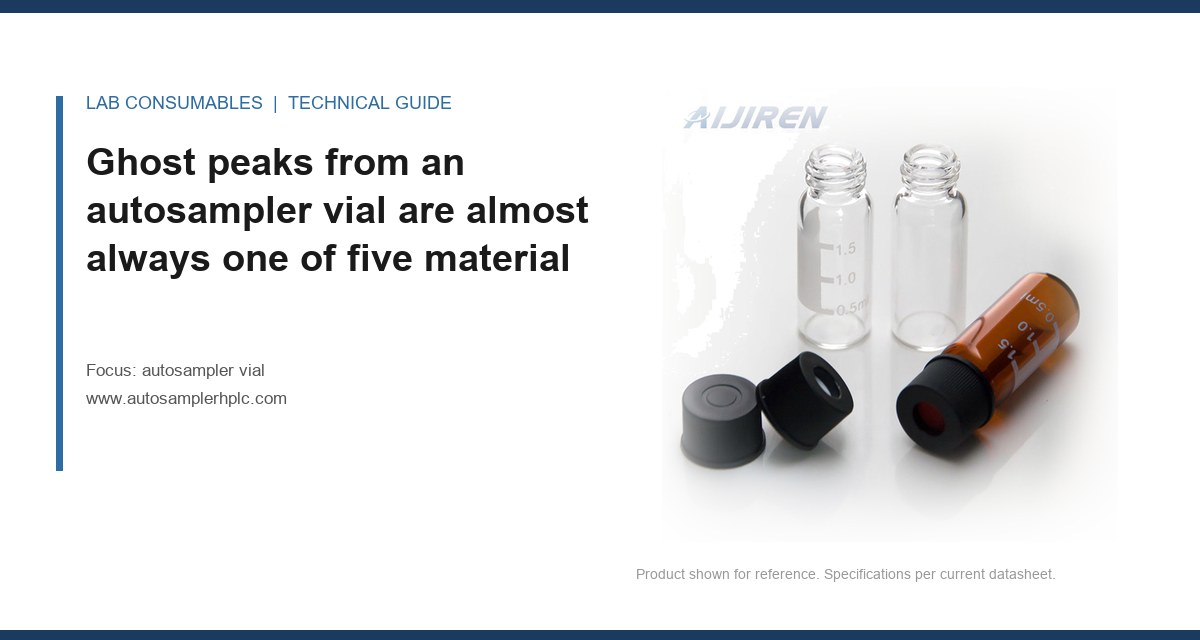
A 20-injection sequence on a 1260 Infinity II running EPA 8270 semivolatiles came back with a siloxane peak at tR 14.2 min, m/z 281, 207, 73, present in all 20 blanks at 0.8 to 1.4 µg/L and absent from the solvent blank run straight off the injector. The instrument was clean. The column was three weeks old. The autosampler vial ghost peaks were coming from the vial, and specifically from a lot of silicone-laminated septa that had been sitting in a warehouse since 2022. I have chased this exact failure four times in twelve years, and every time the answer was extractables from a material nobody specified at the purchasing level. This article is about which materials bleed what, at what temperature, and how to prove it with blank and placebo injections before you start pulling the column.
Ghost peaks from an autosampler vial are almost always one of five material sources
When a peak appears in a blank that was never in the sample, the source is either the instrument, the mobile phase, the column, or the vial. If the peak survives a fresh mobile phase, a column bake-out, and a needle rinse, the vial is the remaining suspect. The autosampler vial ghost peaks, extractables and contamination problem breaks down into five material categories, and each has a signature:
- Silicone (PDMS) from septum laminations and septa themselves. Cyclic siloxanes D3 through D10, plus silanols. Diagnostic ions m/z 73, 207, 281, 341, 355, 429. Bleeds above 60 °C. This is the single most common source in my experience.
- Hydrocarbon oils from mold release and stamping. Alkanes C12 to C30, unresolved complex mixture in GC-MS, or a rising baseline in HPLC-UV at 210 nm. Present on the glass or the cap, not the septum.
- Phthalates and adipates from plastic caps, septa, and vial trays. DEHP at m/z 149, DBP at 149 and 205, plus dioctyl adipate. Leaches into acetonitrile and methanol, worse into aqueous at pH above 7.
- Antioxidants and slip agents from polypropylene and polyethylene. Irgafos 168 (m/z 441, 647), Irganox 1076 (m/z 530), erucamide (m/z 337). Common with plastic-bodied vials and snap caps.
- Residual manufacturing chemistry on the glass. Sulfur from the glass melt (m/z 64, 32), sodium and boron from borosilicate hydrolysis, and occasionally chloride. Shows up in aqueous blanks, not organic.
If you are running headspace or SPME, the septum sits at 80 to 150 °C for the entire incubation, and the silicone contribution multiplies. That is a different specification problem, and the headspace vial conversation belongs there. For LC and direct-injection GC, the vial is at 4 to 40 °C and the dominant contributors are the cap, the septum at ambient, and the glass itself.
What each material actually releases, and at what temperature
I keep a working table for this. It is not exhaustive, but it covers the materials that show up on a autosampler vial spec sheet and the compounds I have actually identified in blanks.
| Material | Primary extractables | Onset temperature | Typical blank level (GC-MS scan) |
|---|---|---|---|
| Silicone septum, 1.0 mm, unslit | D4-D10 cyclosiloxanes, silanols | 60 °C | 0.5 to 5 µg/L per cyclic |
| Silicone septum, 1.0 mm, PTFE-faced both sides | Same, but blocked below the face | 90 °C at the exposed edge | 0.05 to 0.5 µg/L |
| Bromobutyl septum | Brominated hydrocarbons, low siloxane | 110 °C | Below 0.1 µg/L siloxane |
| PTFE/silicone laminated, 0.9 mm | Siloxane from cut edge only | Cut edge degrades at 80 °C | 0.1 to 1 µg/L |
| Polypropylene cap | Irgafos 168, Irganox 1076, erucamide | Ambient (leach) | 0.2 to 2 µg/L in MeOH |
| Borosilicate 33 glass, USP Type I | Sulfur (m/z 64), sodium, boron | Elevated at pH > 7 | Below 0.5 µg/L in water |
| Soda-lime glass (Type III) | Na, Ca, Si, higher alkali leach | Ambient in aqueous | 2 to 20 µg/L sodium |
Two numbers in that table matter more than the rest. The 60 °C silicone onset is why room-temperature LC rarely sees siloxane from a good septum, and why headspace at 90 °C sees it in every blank. The cut-edge exposure on a laminated septum is why a PTFE-faced septum is not a guarantee: the punch that cut the 8 mm disc left a raw silicone ring on the edge, and that ring is what off-gasses when the vial sits on a 40 °C autosampler tray for six hours.
Why the silicone signature is so easy to misread
Cyclosiloxanes look like column bleed. Both give m/z 73 and 207. The difference is that column bleed is continuous and rises with temperature, while septum extractables come as discrete peaks at fixed retention times that do not shift with the temperature program. If you see m/z 281 at tR 14.2 in the blank and at tR 14.2 in the sample, and the peak height is the same in both, you have a vial contribution, not a column problem. If the peak grows when you raise the inlet temperature, it is the inlet septum, not the vial septum. That distinction saves you a column.
How to isolate the source with blank and placebo injections
You cannot fix this without a controlled experiment. The good news is that it takes one afternoon and four injections. The design is a ladder, and each rung removes one variable.
The four-injection ladder
- Solvent blank from the bottle. Draw 1 mL of your mobile phase or diluent directly from the reservoir with a gastight syringe and inject manually. This is your zero. If the ghost peak is here, the problem is upstream of the vial and you can stop reading.
- Solvent blank through the autosampler, fresh vial. Same solvent, drawn from a freshly opened vial of a lot you trust, capped and placed in the tray. Any peak that appears here and not in step 1 is either the vial or the needle path.
- Solvent blank through the autosampler, suspect vial. Same solvent, drawn from the vial lot under investigation. The delta between step 2 and step 3 is the vial contribution, full stop.
- Placebo injection. If you have a matrix-matched placebo (the sample matrix without the analyte), inject it from the suspect vial. This is the only way to separate vial extractables from matrix co-extractives that happen to co-elute. A placebo that is clean in a good vial and dirty in a bad vial is the proof you need for a supplier claim.
Run the four in the same sequence, same column, same method, and inject each one twice. The RSD between duplicates tells you whether the contribution is stable (a material property) or sporadic (a handling problem). A stable 0.9 µg/L from a suspect lot is a material failure. A 0.2 to 1.8 µg/L spread is a handling or storage problem, and you should look at how the vials were stored before you call the supplier.
What “clean” actually means on the blank
I set the acceptance threshold at no more than 10% of the lowest calibration standard’s response for any single peak in the blank, and no more than 3% of the LOQ for the method. For a 1 µg/L LOQ, that is 0.03 µg/L, which is aggressive. Most good lots pass at 0.05 to 0.1 µg/L for siloxane. If your lot is at 0.5 µg/L, you have a problem whether or not the peak interferes with an analyte today, because the day you add a method for a compound at that retention time, you inherit a ghost. This is the same logic behind EPA SW-846 batch QC, where the method blank is part of the analytical batch and the container is part of the container set.
Field case 1: the siloxane peak that followed the septa lot
A contract lab running 8270 had a persistent m/z 281 peak at 0.6 to 1.2 µg/L in every method blank for three weeks. They had replaced the column, baked the inlet, replaced the inlet septum, and cleaned the source. The peak survived all of it. I asked them to run the four-injection ladder. Step 1 (bottle blank) was clean. Step 2 (fresh vial from a new lot) was clean. Step 3 (suspect vial) gave 1.1 µg/L of the same peak. The delta was 1.1 µg/L, attributable entirely to the vial.
The septa were 1.0 mm silicone, unslit, from a lot with a 2022 manufacture date and no foil pouch. Silicone absorbs ambient volatiles over time, and a septum that has sat in a cardboard box for two years will off-gas more than a fresh one. The fix was to switch to a PTFE-faced silicone septum, 1.0 mm, slit, from a lot within 12 months of manufacture, and to store the boxes in a sealed bag with desiccant. The blank dropped to 0.08 µg/L within one run. The cost difference was $0.04 per vial. That is the entire story.
Field case 2: the phthalate that only appeared in acetonitrile
A different lab, running pesticides by LC-MS/MS, saw a DEHP peak at m/z 149 in every blank at 2 to 4 µg/L. The vial was a 2 mL clear glass with a polypropylene screw cap and a PTFE/silicone septum. The blank was 50:50 acetonitrile:water. When they switched the diluent to 100% water, the DEHP dropped to below 0.2 µg/L. The extractable was coming from the polypropylene cap, and acetonitrile was the solvent that pulled it out.
We confirmed it by capping the same vials with PTFE-lined phenolic caps and re-running. DEHP went to below 0.1 µg/L. The polypropylene cap was the source, and the septa were innocent. This is why the cap material belongs on the specification, not just the septum. If your method uses acetonitrile or methanol as the diluent, a polypropylene cap is a liability at the 1 µg/L level.
The fix in that case was a switch to a phenolic cap with a PTFE/silicone septum for the acetonitrile methods, and a separate SKU with a polypropylene cap for the aqueous methods. Two SKUs, one decision rule: match the cap polymer to the diluent, not to the price list. If you want to see how the cap and vial are specified together, the vial catalogues at vials-filters.com break the cap options out by polymer.
Storage and handling conditions that turn a good lot into a ghost peak source
A vial that was clean at the factory is not clean after six months in a lab drawer next to a bottle of toluene. Three handling variables dominate:
- Ambient absorption. Silicone and butyl absorb solvent vapors. A septum stored near an open solvent bottle will pick up that solvent and release it into the next vial. Store septa and capped vials in a sealed bag, away from solvent cabinets.
- Temperature cycling. A pallet that went through a hot truck in July and a cold warehouse in January has been through 40 °C swings. Silicone does not like it. Ask your supplier for the shipping and storage temperature range in writing.
- Lot age. I set a hard rule: no septum older than 18 months from manufacture date, and no more than 12 months for headspace work. This is a purchasing decision, not a lab decision, and it belongs in the supplier agreement.
The glass itself is more forgiving. Borosilicate Type I is stable for years if it is dry and capped. The failure mode is aqueous leaching at high pH, and that shows up as sodium and boron, not as an organic ghost peak. If you are running a pH 9 buffer through a glass vial for 24 hours, you will see it.
Specification checklist for a low-extractable vial
When you write the next PO, these are the parameters that actually control ghost peaks. Everything else is mechanical fit, which is a separate conversation.
| Parameter | Specification | Why |
|---|---|---|
| Glass type | USP Type I borosilicate, 33 expansion | Low alkali leach, stable at pH 2 to 8 |
| Septum material | PTFE-faced silicone, 1.0 mm, slit | Blocks silicone from the sample side |
| Septum age | Within 18 months of manufacture | Reduces absorbed volatiles |
| Cap polymer | Phenolic for organic diluents; PP for aqueous | Avoids phthalate and antioxidant leach |
| Vial cleanliness | Blank below 0.1 µg/L siloxane by GC-MS | Defines “clean” in a testable way |
| Packaging | Foil pouch with desiccant, not cardboard | Prevents ambient absorption in transit |
| Certificate | Lot-specific extractables report | Gives you recourse when a lot drifts |
That last row is the one most labs skip. A lot-specific extractables report is the only document that lets you reject a shipment on a technical basis. Without it, you are arguing with a supplier about a peak you cannot attribute. Ask for it before the first order, not after the first ghost peak.
Troubleshooting sequence when a ghost peak appears
Run this in order. Do not skip steps. The temptation is to jump to the column, and the column is almost never the answer.
- Confirm the peak is in the blank. If it is only in the sample, it is not a vial contribution, it is a matrix or carryover problem.
- Run the bottle blank (step 1 of the ladder). Clean bottle blank rules out the mobile phase.
- Run a fresh vial from a known-good lot. Clean here rules out the needle path and the instrument.
- Run the suspect vial. The delta is your vial contribution.
- Run a placebo from both vials. Separates vial extractables from matrix co-extractives.
- Check the septum lot date and storage. If the lot is older than 18 months, replace it and re-run.
- Check the cap polymer against the diluent. If the diluent is acetonitrile or methanol and the cap is polypropylene, that is your suspect.
- Check the inlet temperature and the transfer line. If the ghost peak grows with inlet temperature, it is the inlet septum, not the vial.
- Escalate to the supplier with the lot number and the blank data. This is where the extractables report earns its keep.
If you get through step 9 and the peak is still there, the problem is not the vial, and the next stop is the GC columns and accessories side of the instrument, or the chromatography sample handling path, or the source. The vial is the first suspect, not the only one.
The decision rule I use
Specify the septum and cap as a matched pair to the diluent and the injection temperature, buy the lot with an extractables report, and reject any lot older than 18 months. If a ghost peak appears, run the four-injection ladder before you touch the column, and treat a delta above 0.1 µg/L between a fresh vial and a suspect vial as a vial failure, not a method problem. The Restek technical library has good reference chromatograms for siloxane and phthalate backgrounds if you need to confirm a mass spectrum, and the GC vial side of the supply chain is where the septum specification actually gets made. The autosampler vial ghost peaks, extractables and contamination problem is a materials problem, and it is solved at the purchasing desk, not at the instrument.
References & further reading
Related resources from our lab consumables network:
- Autosampler Vial at autosamplerhplc.com
- Vial at vials-filters.com
- Headspace Vial at headspacevialsupplier.com
- Gc Vial at gcvialfactory.com
External references and standards: