
The auditor asked for the vial lot’s certificate and the injection log side by side. We had 47 injections on a 2 mL clear vial from lot 22-0914, and the log showed the same lot had been used on a different instrument three weeks earlier. The certificate listed 33 expansion as the only dimensional value. That was the moment I understood what EPA method requirements for autosampler vial use actually mean in practice: the vial is a documented sample container, and the paperwork trail has to survive a cross-reference. If your vial documentation stops at “borosilicate glass, 12 x 32 mm,” you are not ready for an audit, no matter how good your chromatography is.
Most people read SW-846 for the extraction and determinative steps and skim the sample handling clauses. That is a mistake. SW-846 is a compendium of methods, not a single document, and the container requirements live in the individual methods plus Chapter One and Chapter Three. Method 8260 (volatile organics by GC/MS) and Method 8270 (semivolatile by GC/MS) both specify container type, headspace allowance, and holding time. Method 3510 and 3520 series tell you what happens to the extract before it reaches the autosampler.
What the methods do not do is name a vial part number. They describe a container: glass, minimum volume, closure type, headspace limit. The autosampler vial is where that description becomes a physical object. When an auditor reads your SOP and then looks at the vial on the tray, they are checking whether the object matches the description in your method write-up. That is the whole game.
What the methods actually constrain
Three constraints recur across the volatile and semivolatile methods, and each one maps to a vial specification:
- Headspace: Method 8260 allows zero headspace for aqueous samples and requires the vial to be filled so no air bubble exceeds 6 mm. That is a fill-volume and closure decision, not a glass decision.
- Holding time: 14 days from collection to analysis for most volatiles, 7 days to extraction for semivolatiles. The vial’s closure has to hold the sample for that window without measurable loss.
- Preservation: pH adjustment with HCl or NaHSO4 to pH less than 2, checked with pH paper, recorded. The vial has to tolerate that pH without leaching or hazing.
None of these say “use a 9 mm screw thread vial with a PTFE-lined silicone septum.” They do not have to. The auditor infers the vial from the method’s container language and then asks you to prove the vial met it. That proof is what the rest of this article is about.
What the auditor asks for first, in the order they ask for it
I have sat through four EPA-style audits and two state waste-program inspections on the same production line. The request sequence is nearly identical every time. Having the documents in this order saves a day of scrambling.
The document stack, top to bottom
| Order | Document | What the auditor checks | Common failure |
|---|---|---|---|
| 1 | Chain of custody form | Collection date, preservation, container count, signatures | Vial count on the form does not match the tray |
| 2 | Vial lot certificate of analysis | Dimensions, glass type, septum composition, lot traceability | Certificate covers the glass but not the septum or cap |
| 3 | Injection log / sequence table | Vial ID, lot, injection time, instrument | Lot number recorded at the batch level, not the vial level |
| 4 | Holding time record | Collection to extraction to analysis against method limits | Extraction date logged, analysis date missing |
| 5 | Preservation record | pH check, reagent lot, analyst initials | pH recorded as “adjusted” with no value |
| 6 | Contamination / carryover check | Method blank, instrument blank, vial blank | Vial blank run once at method validation, never repeated |
| 7 | Corrective action log | Any vial-related deviation and its resolution | Deviations logged as “instrument issue” with no vial reference |
The first thing they read is the chain of custody, because it is the only document that ties the physical sample to the analytical result. If the vial count on the form is 12 and the autosampler tray holds 11, you have a gap before you have said a word about chromatography. I have seen an auditor stop the review at item 1 and ask for the sample receipt log. That is not a good sign for the rest of the day.
The vial lot certificate is where most labs are thin
A lot certificate that says “12 x 32 mm, clear glass, 9 mm screw thread” is not a certificate. It is a description. What the auditor wants to see is the dimensional values with tolerances: neck OD, neck ID, body OD, height, and the critical one, the crimp or thread finish dimensions that determine whether the cap seats. For a 9 mm screw thread vial, the thread finish is defined by GPI 9-425, and the neck OD should measure 9.0 mm plus or minus 0.2 mm. For an 11 mm crimp vial, GPI 11 and a neck OD of 11.0 mm plus or minus 0.2 mm.
I have a standing rule: if the certificate does not list a tolerance, it does not exist. A number without a tolerance is a wish. The auditor will ask what your incoming inspection measures and what your acceptance criteria are. If the certificate says 12.0 mm and your caliper reads 12.3 mm, you need a tolerance to know whether that is a pass or a fail. This is the same discipline that vial suppliers who serve regulated labs build into their release testing, and it is the first thing I audit when I qualify a new source.
The septum is the part the auditor cannot see and will still ask about
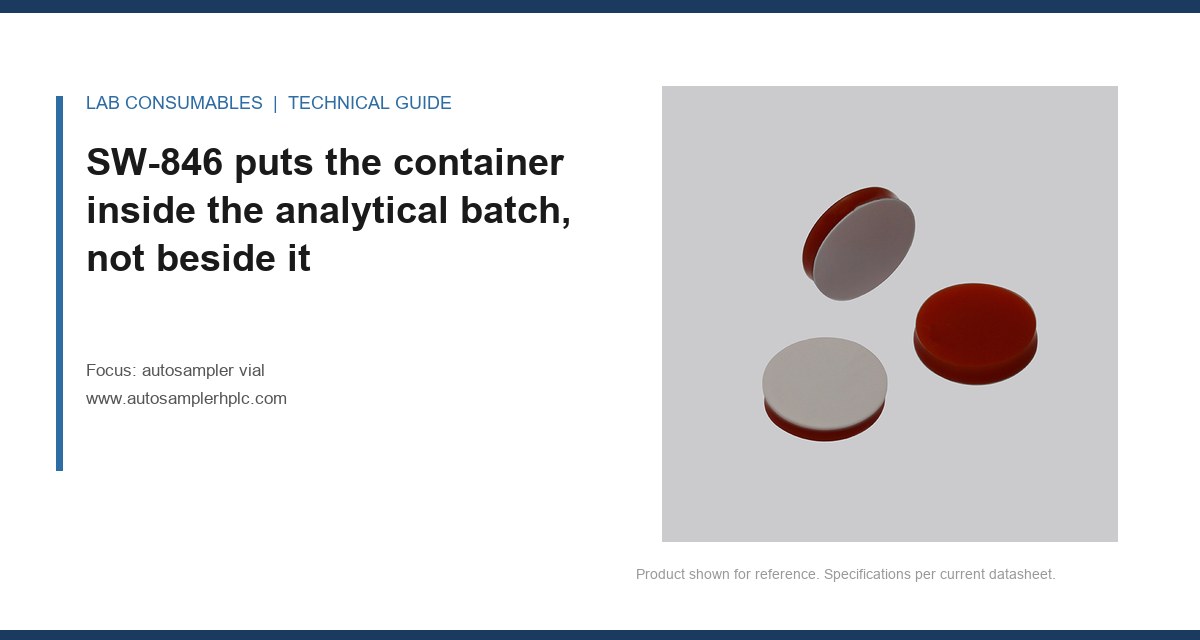
The auditor holds the vial up to the light, looks at the cap, and asks what the septum is made of. If your answer is “silicone,” you have a problem. The septum is a layered composite: a silicone core for resealability and a PTFE face for chemical inertness. The PTFE face is what touches the sample. The silicone is what provides the compression. A septum with no PTFE face will absorb semivolatiles and give you low recoveries that look like a method problem.
For EPA work, the septum specification I insist on is a PTFE-faced silicone, 1.0 mm or 1.5 mm thick, with the PTFE face on the sample side. For volatile methods, a bonded septum in a screw cap is better than a loose septum in a crimp cap because the bonding prevents the septum from being pushed into the vial during injection. The puncture count matters too: a standard silicone/PTFE septum holds about 3 to 5 punctures before coring risk climbs. If your sequence runs 10 injections from one vial, you are past the reliable window and the auditor’s carryover check will show it.
What the auditor does with a septum answer
They write it down and then they look at your method blank. If the method blank shows siloxane peaks at m/z 73, 147, 207, or 281 in a GC/MS run, the septum is the first suspect. Those are the classic silicone markers. A septum that has been punctured too many times, or one that was never PTFE-faced, will bleed them. I have seen a 281 ion peak at 40 percent of the internal standard response in a method blank and traced it to a lot of caps where the PTFE face had a pinhole. The fix was a new cap lot and a puncture-count limit written into the SOP. The auditor’s follow-up question was whether the corrective action was documented. It was not, the first time.
Holding time is a vial property, not a refrigerator property
The 14-day holding time in Method 8260 is measured from collection to analysis. The refrigerator at 4 degrees Celsius slows degradation but does not stop it. What stops it is a closure that does not lose the analyte to the headspace or through the septum. A screw cap torqued to the right value and a septum with an intact PTFE face will hold a volatile sample for the window. A crimp cap that was not crimped to the right dimension will not, no matter how cold the fridge.
This is where the headspace vial specification diverges from the standard autosampler vial and why you cannot substitute one for the other in a method that specifies headspace. A headspace vial is designed for a controlled headspace volume and a crimp or screw finish that holds pressure at the sampler’s incubation temperature, typically 40 to 80 degrees Celsius. A standard 2 mL autosampler vial filled to 1.5 mL and capped with a screw thread is not the same object, and an auditor who knows the method will catch the substitution.
Field case: the 11-day sample that failed at day 13
Symptom: a batch of 20 groundwater samples for Method 8260 showed benzene recoveries dropping from 95 percent at day 3 to 62 percent at day 13. The instrument was clean, the calibration was current, and the method blank was flat. The measurement that identified it: we ran the same sample in three vial types, a crimp vial, a screw thread vial with a loose septum, and a screw thread vial with a bonded septum, and held all three at 4 degrees Celsius for 13 days. The crimp vial lost 8 percent, the loose-septum screw vial lost 31 percent, and the bonded screw vial lost 4 percent. The fix was a switch to bonded screw caps for all volatile work and a torque specification of 1.5 to 2.0 inch-pounds on the capper. The auditor’s question after that was whether the switch was documented in the SOP revision history. It was, with a date and a reason.
Carryover checks are where the vial gets blamed for the instrument
The auditor asks for the carryover check and the vial blank. These are different tests. The carryover check runs a high standard followed by a blank and measures the blank response against a limit, typically less than the method reporting limit or less than 5 percent of the high standard. The vial blank runs a fresh vial filled with reagent water through the full sequence to prove the vial itself contributes nothing. Most labs run the carryover check every batch and the vial blank once at validation. That asymmetry is what the auditor probes.
If the carryover check fails, the first suspect is the injection port, the syringe, or the needle. The second suspect is the vial. A vial with a cored septum, a scratched neck, or a cap that did not seal will show a response in the blank that looks like carryover but is actually a leak or a septum artifact. The way to tell them apart is the vial blank: if the vial blank is clean and the carryover blank is not, the problem is upstream of the vial. If the vial blank is dirty, the vial is the problem.
Field case: the 3 percent carryover that was a cap
Symptom: carryover for a semivolatile method sat at 3 percent of the high standard, just under the 5 percent limit, for six weeks. The instrument was serviced twice. The measurement that identified it: we swapped the cap lot on the same vial lot and the carryover dropped to 0.4 percent. The cap thread finish on the old lot measured 9.3 mm against a 9.0 mm nominal, outside the plus or minus 0.2 mm window. The cap was seating on the thread but not compressing the septum fully, so a thin film of sample sat between the septum and the neck and bled into the next injection. The fix was an incoming inspection on the cap thread finish with a go/no-go gauge and a rejection of the lot. That is a GPI 9-425 conformance check, and it takes about 15 seconds per cap with the right gauge.
The incoming inspection that survives an audit
An auditor who has seen a few vial-related deviations will ask to see your incoming inspection records. What they want to know is whether you check the vial before it enters the batch or after it fails. The answer has to be before. The inspection does not need to be elaborate, but it needs to be specific and recorded.
- Dimensional check: neck OD, body OD, height, and thread finish against the GPI specification. Sample size of at least 10 vials per lot, AQL of 1.0.
- Visual check: chips at the neck, bubbles in the glass, septum face integrity, cap seating. Reject any lot with visible defects in the sample.
- Fit check: seat a cap on a sample vial and confirm it compresses the septum without bottoming out. A cap that bottoms out before compressing the septum is a leak waiting to happen.
- Functional check: run one vial from the lot through a blank injection and confirm no siloxane or phthalate peaks above the reporting limit.
The records for these checks go in the same file as the lot certificate. When the auditor asks for the certificate, hand them the inspection record with it. The conversation changes from “do you have documentation” to “here is the documentation.” That is the difference between a finding and a clean review.
Where the method language and the vial catalog do not line up
Here is the uncomfortable part. The EPA methods describe containers in functional terms, and the vial catalog describes them in dimensional terms. The bridge between the two is your SOP. If your SOP says “2 mL clear glass vial, 9 mm screw thread, PTFE-lined silicone septum, bonded,” and your method write-up says “glass container with zero headspace,” the auditor has to take your word that the vial meets the method. That is a weak position. The stronger position is an SOP that cites the method clause and the vial specification on the same line, with the lot certificate attached.
I have built that bridge on three production lines. The format that works is a one-page container specification sheet per method, listing the method number, the container clause, the vial part number, the cap part number, the septum specification, the fill volume, the torque value, and the holding time. The auditor reads one page and has the whole story. The autosampler vial on the tray and the vial on the specification sheet are the same object, and the paperwork proves it.
Comparison: what each method family expects from the container
| Method family | Container clause | Vial implication | Audit check |
|---|---|---|---|
| 8260 (volatiles) | Zero headspace, 6 mm bubble max, 14-day hold | Screw thread, bonded PTFE septum, fill to shoulder | Bubble check on receipt, holding time log |
| 8270 (semivolatiles) | Amber glass, 7-day to extraction, 40-day to analysis | Amber vial, PTFE septum, no plastic contact | Extraction date vs collection date |
| 3510/3520 (extraction) | Container compatible with solvent | Glass only, no polystyrene, no adhesive labels on the neck | Solvent compatibility note in SOP |
| Headspace (8015/8260 by HS) | Pressurized container, incubation temperature | Crimp or screw headspace vial, 20 mm finish | Pressure rating and incubation record |
The headspace row is the one that trips people up. A 20 mm crimp headspace vial is not interchangeable with a 9 mm screw autosampler vial, and the auditor knows it. If your method says headspace and your tray holds 9 mm screw vials, you have a method deviation before you have a result. The GC vial specification has to match the sampler’s head, and the head has to match the method. That chain is what the auditor walks.
What to fix before the auditor walks in
If I were prepping a lab for an EPA-style audit next week, I would do five things in this order. First, pull every vial lot certificate and check that it has tolerances, not just nominal values. Second, write the container specification sheet per method and attach the certificates. Third, add a vial blank to every batch, not just validation. Fourth, set a puncture-count limit in the SOP, 3 for silicone/PTFE and 5 for bonded, and log the count per vial. Fifth, put a go/no-go gauge on the incoming bench and record the cap thread finish check. None of these cost much. All of them turn a finding into a documented control.
The decision rule is simple. If the vial specification, the method clause, and the lot certificate do not line up on one page, the auditor will find the gap. The vial is the smallest piece of hardware in the method and the easiest one to leave undocumented. Document it first, and the rest of the audit is about the instrument, where you have more control. The supply chain for these parts is well covered by the major vendors, and the technical references from Agilent, Thermo Fisher, and Restek will give you the dimensional and septum data you need to write the specification sheet. The paperwork is your job, not theirs.
References & further reading
Related resources from our lab consumables network:
- Autosampler Vial at autosamplerhplc.com
- Vial at vials-filters.com
- Headspace Vial at headspacevialsupplier.com
- Gc Vial at gcvialfactory.com
External references and standards: